Wednesday, September 7, 2011

This isn't your old school culture...or is it?

Schools are communities, and communities of all kinds express themselves through their culture. At Domus Academy, like Domus' two charter schools in Stamford, our culture is different from that of many other schools. It takes some getting used to, but that culture exists to remove all distractions and help students be ready to learn--it also helps children learn skills they'll need to be successful later in life.

  • We set up each classroom, be it art or math or social studies, to have the same whiteboard arrangement and information. This saves time--time kids can use learning something instead of on figuring out where to find an assignment.
  • We require students to mentally and physically prepare themselves for learning: In the hallways, they must be quiet and physically still (so as not to distract themselves or other students).
  • We require uniforms, which means kids don't have to worry about having the "right" shoes or jeans. (It also reduces funds a parent or caregiver must spend on trendy school clothes). 
  • We require students to tuck in their shirts and wear a belt so they look neat; learning is fun but also serious business. 
  • We tell kids all the time what we expect--we want them to succeed, and the faster they figure things out, the faster they get to the good stuff.
  • We set high expectations: We expect them to behave appropriately, to focus, to work hard. Adults who cannot or will not set high expectations for students cannot be part of our school community.
  • We require students shake a teacher's hand and look him or her in the eye as they enter each classroom, every time: These are fundamental skills everyone needs to be successful in life. (Plus, it's just polite.)
  • We never give up on a child. There's always a place for a young person to find success, and while we expect a lot from a young person, we also expect adults responsible for his success (ourselves included) to find or create a place where each child to reach his full potential.
Did your school have a strong culture? How important is culture in creating a successful educational environment? Who's doing a great job at creating that culture? (We like visiting other schools who are getting it right.)

Thursday, September 1, 2011

First day!

For many Domus Academy students, today is a day of culture shock.

"Tuck in your shirt, please."
"We'll walk down the hall when we're in a straight line and are all quiet."

But for Esteban, these rules are no surprise.

Esteban, who's now in 7th grade, tells me he got in "lots of fights last year." But he's glad to be back at Domus Academy this year and happy to see so many staff members have returned. "This year," he says firmly, "I'm going to be respectful."

He's also going to be a leader, which he tells me later as he helps his classmates stay focused on how to properly enter the classroom, which doesn't include the current chatter and horseplay.

Esteban has his eyes on the prize. And through this blog, you'll meet many more students who do as well.

Check out our photo album with snaps from Day 1.

Tuesday, August 30, 2011

Overheard at tonight's orientation & BBQ

Scene: Two gangling, smiling boys walking down the hallway together after scoping out the gym at their new school...
"Man, I hope you're in my class this year."
"Yeah, me too. This is going to be fun!" 


Yep, two adolescent boys genuinely happy about returning to school.


Watch for photos from the first day of school (whenever that is...).

Wednesday, August 17, 2011

What our social services team did on *their* summer vacation

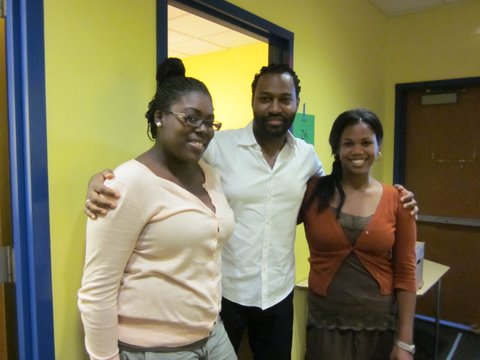
Family Advocates Porchia Wright and Paul Smith with Director of Social Services Ashley Hampton

Domus schools employ the use of social services teams to address complex social and emotional needs youth in our schools often face. The Domus Academy social services team made 35 home visits this summer, a key way to build relationships so kids and families understand our only agenda is their success. That trust is critical when we need a kid in the middle of a meltdown to listen to us, or when we have to have a tough conversation. Home visits also help us learn about a family: All the little things you discover about someone when you sit down over tea in their living room help us understand where a family is coming from so we can be respectful of and better understand their beliefs and experiences. 


It all goes back to a Domus core value: Loving relationships change people. When kids understand we love them, and they trust we have their best interests at heart, they become open to making positive change and know we'll help them make that change. We hope you'll watch that wonderful process unfold this year.

Wednesday, August 10, 2011

What I did on my summer vacation

Our school staff spent the summer, in addition to doing dozens of home visits to families, working on the tools they need to make sure Domus Academy is a rigorous learning environment with high expectations and a strong school culture. Last year, we were very successful creating trusting individual relationships with students, which helped us move beyond the lack of hope, motivation, and interest we saw in our students—despite their tremendous academic potential.

This year, we want to pair that keen ability to develop relationships with a focus on core values. In fact, we’re spending the first month of school on a school-wide core values unit centered on the names of our students’ homerooms: ICARE (Integrity – Community – Ambition – Respect – Empathy). Each value has associated with it three to five tangible behaviors and actions; students will self-report on how they’re doing, and staff will weigh in as well.

Along with this focus on school culture will be an increased focus on guided reading utilizing a new leveled library, providing students with engaging materials at their reading level. Columbia University’s Readers and Writers Workshop, a method of instruction successfully used in schools for over twenty years, is particularly helpful for schools and classrooms with students reading at a variety of levels. Our students will now be able to find many interesting books at their level and. Students practice skills like inference in a classroom setting, with their teacher modeling the skill, then do small-group classroom work, then independent work on their level using the new leveled library to find interesting books at their individual ability. The more they read books on their reading level, the more successfully they’ll build critical skills such as decoding, fluency, and comprehension.

So Year Two, with its luxury of lessons learned from Year One, will bring a tighter school culture with a foundation of key values and a more rigorous learning environment using proven methods from respected institutions. Add to that our intense social/emotional focus, and you have a whole-child approach to educating youth.

Thursday, August 4, 2011

Domus Academy makes the cover of Yale Magazine


Did you see this spring 2011 story about the kids of Domus Academy? Molly Hensley-Clancy does an outstanding job putting the reader right there in the school hallway to experience the challenges facing our students as well as the issues our staff members must overcome. And don't miss the slideshow.

Wednesday, July 27, 2011

Rashid's dream

On a bulletin board at Domus Academy: Rashid is going to be a chef because “I want to see how happy people are after they taste my food.” We’re expanding our extended day activities to expose kids to new experiences; we’re open to hearing about anything they couldn’t do at home or in their neighborhoods. 

Let us know if you have a talent or skill you want to share: robotics, tango dancing, rugby, baking, gymnastics…what else could we teach our kids that might spark a lifelong hobby or a profession?

Wednesday, July 20, 2011

Domus Academy welcomes new school director Billy Johnson


It feels as though a long-lost relative has finally come home: Billy talks like everyone else at Domus does about having high student expectations, holding everyone accountable for ambitious results, and looking forward instead of back. 

But Billy's also back home...literally. He's a native New Haven son who's back to make an impact after teaching and leading schools for the Middletown Public Schools and Amistad Academy. "I have a huge concern about the gun violence" here in New Haven. His mission here goes beyond the professional realm--helping Domus Academy youth reach their potential is personal.

Billy has been working with our school staff to put a plan in place right now to "make sure our activities align with the mission." His turnaround of Stamford's Stark Elementary School, long the city's lowest-performing school, is well-known, and here, like there, he knows "we must be very intentional about what we do." He's met with every single staff person to hear about where they think their strengths lie and what they believe the school needs. "Everybody [at Domus Academy] believes that kids can do wonderful things." (High expectations? Check.)

Our conversation returned again and again to students, as it does when you talk with any Domus employee. "There are so many great kids with so many great talents, and they haven't been given the space to express themselves in a way" that works for them. He's already created partnerships with city organizations to help us expand the ways we engage students during the day and during our extended-day program.

Another word that popped up again and again? Results. And another: Excuses. 

He wants one of those. Guess which one.


Wednesday, July 13, 2011

Maurice's story

 photo: www.richardfreeda.com

This is Maurice. He just graduated Domus Academy as an 8th grader. Maurice had struggled in his other New Haven schools, and his behavior when he arrived at Domus Academy was...well, "challenging" was the word we used. He wasn't really happy to be in any school, much less ours, and it seems he wasn't shy about letting everyone know. It probably didn't help he was three grades behind in reading and five grades behind in math. It's tough to focus, behave, and have hope when you're so far behind. 
Thankfully, we're like bulldogs: persistent and stubborn.

Maurice is incredibly smart--he loves computers and has a real talent with them--and we knew that once he made the decision to put some effort into his work, he had great potential to do well academically. Maurice didn't trust us right away, so it took awhile for him to turn his grades and behavior around. This spring, Maurice got himself in a tough spot, and he made the right decision. It wasn't an easy call to make, but he did it, and from that point on, we knew he was listening to us. He also came to school on a daily basis. Now, that may not seem like a big deal to you, but it was a complete 180-degree shift for Maurice.

Fast forward to the end of the year: Maurice, our 8th grader three grades behind in reading and five behind in math, met goal on his CMTs, outperforming half his peers across the state and making tremendous progress during the year. I asked Maurice's mom what changed for her son, and she said, "He had a lot of help from Domus Academy. [School director] Mr. McGuire was there for him no matter what. He got into some trouble, but they didn't give up on him."

We know this is just the beginning for this bright young man and look forward to seeing him continue to improve and mature as he attends Hillhouse this fall.

Thursday, July 7, 2011

A student's perspective

It's clear Domus Academy parents value the support our family advocates provide; this blog's previous post highlights just a few of the comments we've heard. But what about students? How do they feel about family advocates?

"My family advocate is someone I can always go to for a listening ear and advice."

"My family advocate is someone who goes to my house and meets with my aunt about what goes on at school and in my neighborhood."

"I love my family advocate--she helps me be successful and helps me work through my anger."


Family advocates continue their work during the summer, making home visits and ensuring youth are connected with critical community resources to hopefully stem the tide of summer slide, the academic loss occurring during the summer which hits youth living in poverty the hardest. Next week, we'll provide an inside look at what summer brings to Domus Academy.